
Thermal challenges in industrial large AC motor applications
Heavy-duty electric machinery such as large motors, drives, and rotating equipment form the backbone of industrial operations in sectors like steel, cement, mining, and material handling. These machines often operate under high mechanical loads, frequent starts and stops, and harsh environmental conditions.
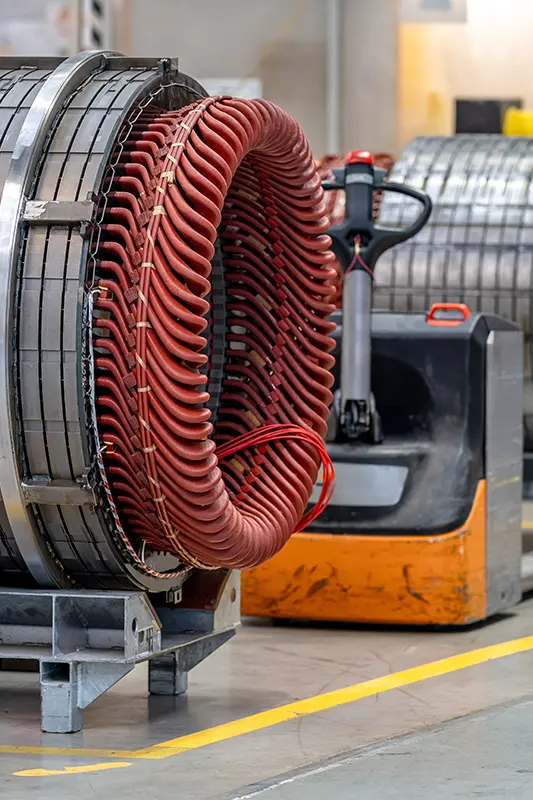
Stator slot RTDs are mainly applied in AC motors above approximately 250 HP, typically corresponding to frame sizes larger than 400 mm. As electrical current passes through stator windings, heat is generated continuously. If this heat is not accurately monitored and controlled, it can accelerate insulation degradation, reduce motor efficiency, and ultimately lead to unplanned downtime or equipment failure. Below this range, motors often rely on simpler protection methods or do not include embedded winding temperature sensors due to cost and space constraints.
Purpose of stator Slot RTD Sensors
Stator slot RTD sensors are temperature sensors installed directly within the stator slots of heavy-duty electric motors. Their slim construction allows them to be positioned alongside winding insulation, enabling direct measurement of winding temperature rather than relying on indirect surface or ambient readings. This placement ensures that the most thermally stressed areas of the machine are monitored with high accuracy.
Temperature monitoring under demanding operating conditions
In heavy-duty machinery, load conditions can vary depending on process demands. Sudden overloads, restricted cooling airflow, or mechanical issues can all cause rapid temperature rises within stator windings. Stator slot RTDs continuously track these temperature changes by measuring resistance variations in the sensing element and transmitting this data to motor protection relays or control systems. The information can be used to:
- Detect abnormal temperature increases during overload or stall conditions
- Provide input for motor protection systems to initiate alarms or controlled shutdowns
- Support efficient maintenance by identifying long-term thermal trends
This real-time insight is particularly valuable in environments where equipment is expected to operate continuously or under extreme duty cycles.
Operational advantages for heavy-duty machinery
Accurate stator temperature measurement delivers several key advantages in industrial motor applications:
- Improved reliability: Early detection of overheating reduces the risk of sudden motor failure and process interruption.
- Extended insulation life: Maintaining winding temperatures within design limits slows thermal aging and preserves insulation integrity.
- Process continuity: Reliable temperature data helps operators run equipment closer to optimal load without exceeding safe thermal limits.
- Lower lifecycle costs: Preventing severe thermal damage minimizes costly rewinds, replacements, and unplanned outages.
Common industrial applications
Stator slot RTD sensors are widely used in heavy-duty electric machinery such as large synchronous and induction motors driving crushers, mills, fans, pumps, conveyors, and compressors. These applications are common in steel and metal processing plants, cement production, mining operations, and paper mills, where motors are critical to continuous production. In each case, stator slot RTDs provide early warning of overheating, helping protect valuable assets and maintain stable and efficient industrial operations. Below a list of large AC motors where stator slot RTD sensors can be found:
- Crusher drive motors (>250 HP, IEC 400–560)
- Mill drive motors (>500 HP, IEC 450–630)
- Large process pump motors (>250 HP, IEC 400–560)
- High-capacity fan and blower motors (>250 HP, IEC 400–500)
- Compressor drive motors (>300 HP, IEC 400–560)
- Paper and pulp process motors (>250 HP, IEC 400–560)
- Large extruder and mixer motors (>250 HP, IEC 400–500)
Download the stator slot RTD sensor leaflet
Download the stator slot RTD sensor leaflet for a quick overview of its added value, technical specifications, and typical applications.
"*" indicates required fields