
Temperature sensing for electric motors
Electric motors operate under continuous thermal stress, making reliable temperature monitoring essential for protecting winding insulation, preventing unexpected failures and ensuring long-term operational reliability. Depending on the motor design and application, temperature sensing is typically focused on either hotspot detection in the end windings or structural thermal monitoring inside the stator slots.
Kamet offers temperature sensing solutions for both approaches, including Pt100 and Pt1000 sensors with extension wires for hotspot detection and stator slot RTD sensors for large rotating machines. Our solutions combine reliable measurement performance, mechanical robustness and engineering-driven customisation for demanding motor applications.
Product summary
- Solutions for both hotspot detection and structural thermal monitoring
- Reliable temperature measurement under continuous thermal cycling
- Suitable for industrial, energy and mobility applications
- High mechanical robustness and long-term stability
- Engineering support and custom sensor solutions
- Suitable for OEM production, repair and testing environments
The available types of temperature sensing solutions
End-winding hotspot detection
Reliable hotspot detection for electric motors, focused on monitoring local temperature peaks in the end windings.
- Typically based on Pt100 or Pt1000 elements
- Depending on the application, these can be based on thin-film RTD elements or ceramic wire-wound RTD elements
- Cost-effective and easy to integrate
- Suitable for compact motor designs
- Commonly used in small and medium-sized motors
Stator slot RTD sensors
Structural temperature monitoring for large motors and generators, designed to monitor the actual winding temperature inside the stator slots.
- Reliable long-term thermal monitoring
- High mechanical robustness
- Designed for demanding industrial environments
- Suitable for large motors and generators
Looking for another solution?
Contact Kamet to discuss your motor temperature sensing requirements. We work with a broad range of international manufacturers and support you in defining the optimal sensing solution for your application.
Get in touchTemperature sensing in electric motors
Accurate temperature monitoring in electric motors presents challenges beyond standard industrial sensing applications. During operation, motors are continuously exposed to thermal stress caused by electrical loading, cooling limitations and varying operating conditions. Excessive temperatures can accelerate insulation ageing, reduce efficiency and ultimately lead to premature motor failure.
As a result, reliable temperature monitoring is essential for protecting the winding system and ensuring long-term operational reliability. In many applications, temperature sensing is also used to support predictive maintenance strategies and reduce unplanned downtime.
A key consideration is that temperature monitoring in electric motors is generally approached in two different ways, depending on the motor design and application requirements.
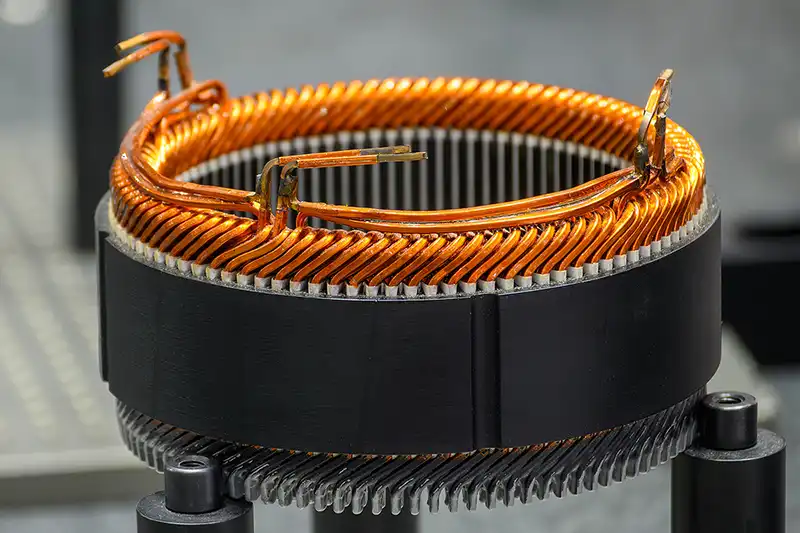
In many small and medium-sized motors, temperature sensing focuses on hotspot detection in the end windings. These regions are mechanically exposed and often thermally less stable, making them more prone to local overheating. In these applications, Pt100 or Pt1000 elements with extension wires are commonly used as a relatively simple and cost-effective solution for thermal protection.
For larger motors and generators, temperature monitoring is often integrated directly inside the stator slots. This approach provides a more representative measurement of the actual winding temperature and the overall thermal condition of the machine. Rather than focusing only on local hotspots, stator slot RTD sensors are used to monitor the long-term thermal load of the insulation system and support reliability-focused machine operation.
Another important factor is long-term sensor stability under continuous thermal cycling and vibration. Electric motors are exposed to repeated heating and cooling cycles during operation, which places mechanical and thermal stress on both the sensor and the lead wire construction. Reliable sensor integration and robust construction are therefore essential to ensure stable measurement performance over time.
Finally, application requirements such as motor size, cooling concept, operating environment and cost targets all influence the optimal sensing strategy. The combination of the correct sensor technology with suitable installation methods and reliable lead wire configurations ensures accurate and stable temperature monitoring throughout the lifetime of the machine.
Why different temperature sensing approaches are used
Temperature monitoring in electric motors is not based on a single sensing philosophy. Different motor types and applications require different approaches depending on the thermal behaviour of the machine and the level of reliability required.
In smaller motors, the focus is often on detecting local overheating in the end windings. These motors are typically more cost-driven and designed for high production volumes, where compact sensor solutions and simple integration are important. In these environments, hotspot detection provides sufficient thermal protection for the application.
In larger industrial motors and generators, the focus shifts towards structural thermal monitoring of the stator winding itself. These machines represent high-value assets where insulation lifetime, operational reliability and predictive maintenance become critical. Temperature monitoring inside the stator slots therefore provides a more representative view of the overall thermal condition of the machine.
As a result, the sensor design, installation method and performance requirements can differ significantly between the two approaches. Selecting the correct sensing strategy is therefore an important part of the overall motor design.

Applications
Large motors and generators
For large rotating machines, stator winding temperature monitoring is essential for protecting high-value assets and ensuring long-term reliability.
Typical applications include:
- hydroelectric generators
- synchronous generators
- large industrial motors
- power generation equipment
- critical infrastructure systems
For these applications, stator slot RTD sensors are commonly integrated directly into the stator windings to monitor the thermal condition of the insulation system over long operating periods and help protect against overheating and premature failure.
Small and medium-sized motors
In smaller motors, hotspot detection in the end windings is often sufficient and more cost-effective.
Typical applications include:
- industrial automation
- pumps and fans
- mobility systems
- compact industrial drives
- OEM motor production
Pt100 and Pt1000 sensors with extension wires are widely used in these environments for local overheating detection and thermal protection. Depending on the application, these can be based on compact thin film RTD elements or higher-stability ceramic wire wound RTD elements.
Motor repair and refurbishment
Temperature sensors are frequently used in motor repair and rewinding projects, where existing sensing systems need to be replaced or upgraded to improve reliability and extend machine lifetime.
More about the usage of stator slot RTD sensors in repair shops.
Test and validation systems
In motor testing environments, temperature sensors are used to monitor winding temperatures during:
- thermal validation
- overload testing
- efficiency testing
- lifetime testing
- insulation verification
Kamet’s solutions for electric motors
Kamet supplies temperature sensing solutions tailored to electric motor applications.
Our portfolio includes:
- stator slot RTD sensors for large motors and generators
- Pt100 and Pt1000 sensors with extension wires for hotspot detection
- mineral insulated cables and components for demanding environments
- custom sensor assemblies for rotating machinery
We support customers from the design phase to series production, helping to define the optimal sensing solution based on the thermal monitoring strategy of the machine.
